Welcome back to The FinTech Verdict. I’m your Senior Financial Analyst, and today we’re tackling one of the biggest financial decisions a homeowner can make: knowing the exact right moment to refinance your mortgage. This is not a choice to be taken lightly; a successful refinance can save you tens of thousands of dollars over the life of your loan, but a poorly timed one can cost you money through unnecessary fees.
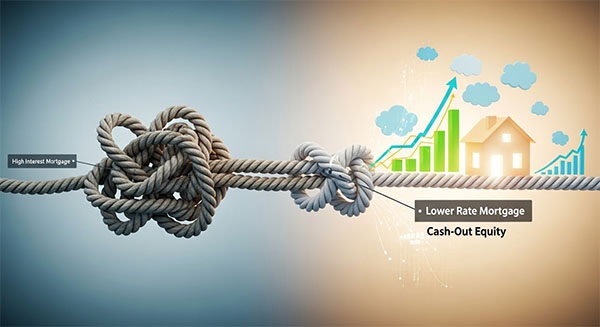
The market for refinancing is aggressive, and lenders are constantly battling for your business. The decision to refinance your mortgage is driven by two main goals: lowering your monthly payments through a better interest rate (Rate-and-Term Refinance) or tapping into your home’s value (Cash-Out Refinance). In both cases, success hinges on careful calculation of the closing costs and determining your break-even point.
This comprehensive analysis will cut through the noise, providing a definitive framework for when the math makes sense to execute a refinance. We will explore the different types of refinancing, analyze the crucial financial health metrics like your FICO Score and debt-to-income ratio, and guide you through choosing the best lender platform to secure the lowest mortgage APR. Your goal is maximum savings and optimal home equity utilization.
The Core Mechanics: Why and When to Refinance Your Mortgage
Refinancing means replacing your existing mortgage with a brand new one. It involves calculating the savings from a lower mortgage APR against the immediate cost of the new closing costs. The main reason for refinancing is almost always to improve your financial position, either by saving money monthly or accessing capital.
The Two Primary Refinance Types
1. Rate-and-Term Refinance: This is the most common type, aimed purely at lowering your mortgage APR or adjusting the loan term (e.g., moving from a 30-year to a 15-year fixed rate). The primary rule of thumb here is the “2% Rule,” suggesting a refinance is likely worth considering if you can secure an APR at least 2% lower than your current rate, although even a 1% drop can be beneficial depending on your remaining loan term and closing costs.
2. Cash-Out Refinance: This strategy allows you to tap into your home equity, replacing your old mortgage with a larger one and taking the difference in cash. This is a common method for funding major home improvements, consolidating high-interest debt (like revolving credit from credit cards, as discussed in our Debt Consolidation Loan analysis), or paying for education. This option increases your total debt but provides low-interest capital.
The Critical Break-Even Point
A refinance is never truly “free.” Closing costs (including appraisal fees, title insurance, and lender fees) typically run between 2% and 6% of the loan principal. You must calculate the break-even point: the amount of time it takes for your monthly savings from the lower mortgage APR to equal the total closing costs. For example, if costs are $6,000 and you save $200 per month, your break-even point is 30 months. If you plan to move before 30 months, the refinance is not worth the expense.
3 Best Lending Platforms for Refinancing in 2026
Choosing the right lender is crucial to minimizing closing costs and securing the lowest mortgage APR. We compare three top players representing different lending styles in the U.S. market.
Rocket Mortgage (Quicken Loans): Best for Speed and Digital Experience
Rocket Mortgage, formerly Quicken Loans, is the largest mortgage originator in the US and is renowned for its proprietary online platform. They offer a fast, fully digital application process, often requiring minimal paper documentation, making them excellent for busy borrowers seeking an efficient rate-and-term refinance. Their large volume means they can often be highly competitive on mortgage APRs.
The Analyst’s Verdict: Rocket Mortgage is ideal for the tech-savvy borrower with an excellent FICO Score who values speed and a transparent digital interface. While they may not always offer the absolute lowest rate, the guaranteed simplicity and speed of closing often offset a minor difference in the final mortgage APR.
LoanDepot: Best for Competitive Rates and Diverse Loan Products
LoanDepot is a leading non-bank lender that focuses on highly competitive rates and offers a wide variety of specialized loan products, including FHA, VA, and different cash-out refinance options. They often run aggressive marketing campaigns to undercut rates from larger banks, making them a key platform to check when shopping for the lowest possible mortgage APR.
The Analyst’s Verdict: LoanDepot is a must-shop destination for every borrower seeking to refinance your mortgage, particularly those interested in a cash-out refinance. Their flexibility in underwriting often makes them suitable for borrowers whose loan-to-value ratio or debt-to-income ratio may be slightly outside the strictest limits of traditional banks.
Wells Fargo: Best for Relationship Banking and Existing Customers
Wells Fargo, as a massive Traditional Bank, offers unique advantages, particularly for existing customers. If you have an existing checking or retirement savings account with them, they may offer preferred pricing, significantly reducing closing costs or shaving a fraction off the final mortgage APR. Their in-person consultation services can be valuable for complex cash-out refinance scenarios.
The Analyst’s Verdict: If you value the stability of a Traditional Bank and already have a long-standing banking relationship, Wells Fargo should be your first stop. Leverage your existing relationship to negotiate lower closing costs and potentially bypass the hard inquiry shopping phase that other lenders require.
The Strategic Refinance Checklist: FICO, DTI, and LTV
Before you apply to refinance your mortgage, you must ensure your personal financial metrics are optimized to qualify for the best possible mortgage APR and minimize closing costs.
Optimizing Your FICO Score and Credit Profile
A top-tier FICO Score (740+) is non-negotiable for securing the lowest mortgage APR. Lenders use your FICO Score to assess risk, and even a 20-point difference can cost you thousands in interest over the loan term. Before applying, ensure your Credit Utilization Ratio is below 10% on all revolving credit accounts (credit cards) and avoid any new debt or loan inquiries, as these result in a hard inquiry that temporarily lowers your score.
Calculating the Debt-to-Income Ratio (DTI)
Your debt-to-income ratio (DTI) is a crucial metric, representing the percentage of your gross monthly income that goes toward paying debts (including the proposed new mortgage payment). Most lenders prefer a DTI below 43%, though 36% or lower is ideal. A high DTI will result in a significantly higher mortgage APR or outright rejection. This is why paying off high-interest personal loans or revolving credit balances before applying is essential.
Assessing the Loan-to-Value Ratio (LTV)
Your loan-to-value ratio (LTV) is calculated by dividing your current loan balance by the appraised value of your home. A lower LTV (ideally 80% or below) is key. If you are doing a cash-out refinance, lenders typically require an LTV of 80% or less. If your LTV is above 80%, you may be required to pay Private Mortgage Insurance (PMI), which adds to your monthly cost and erodes the benefit of the lower mortgage APR.
Making the Final Decision on Refinancing (Costs, Risk, and Transparency)
The final verdict on whether to refinance your mortgage must be based on a cold, transparent analysis of costs and risk.
1. Scrutinize the Closing Costs: Obtain itemized estimates from at least three different lenders. Closing costs should be viewed as an investment in a lower mortgage APR. Never accept a “no-closing-cost” refinance without understanding that the costs are simply rolled into your principal or result in a slightly higher mortgage APR. Always opt for the path with the lowest overall long-term cost.
2. Minimize the Hard Inquiry Risk: Shopping for a mortgage involves multiple hard inquiry pulls on your credit report. Fortunately, credit scoring models typically group multiple hard inquiry pulls for the same type of loan within a short window (14 to 45 days) and treat them as a single inquiry. Shop aggressively within a focused 30-day window to minimize the impact on your FICO Score.
3. Choose the Right Loan Term: If you only care about the lowest possible monthly payment, opt for a 30-year term. If your goal is to save the most money overall and pay off the debt quickly, opt for a 15-year fixed rate loan. The difference in total interest paid over time is staggering, reinforcing the need for long-term strategic thinking.
For guidance on comparing loan estimates, understanding your rights, and ensuring compliance with federal lending laws, the Consumer Financial Protection Bureau (CFPB) provides detailed information.
Refinance Your Mortgage FAQs
❓ What is the typical mortgage APR difference needed to justify a refinance?
Many analysts use the “2% Rule” (your new mortgage APR should be 2% lower than your current one). However, a more accurate approach is the “2-Year Rule”: you must be able to hit your break-even point (recovering all closing costs through monthly savings) within two years or less.
❓ How is a cash-out refinance different from a Home Equity Line of Credit (HELOC)?
Both allow you to access home equity. A cash-out refinance replaces your entire existing mortgage with a new, larger one (with a fixed rate). A HELOC is a separate, secondary loan that functions as revolving credit (often with a variable APR), leaving your original mortgage intact. A HELOC typically has lower closing costs but a potentially higher APR on the drawn amount.
❓ Can I refinance your mortgage if I have poor credit?
It is extremely difficult to refinance your mortgage with a low FICO Score (below 620-640). If you qualify, the resulting mortgage APR and closing costs will be so high that the refinance will likely not be financially beneficial. Focus first on debt consolidation and raising your FICO Score.
❓ What are “no-closing-cost” mortgages?
“No-closing-cost” is misleading. The lender either pays the closing costs for you in exchange for a significantly higher mortgage APR over the life of the loan, or they roll the closing costs into the principal. You must evaluate the higher interest cost against the upfront fee savings to determine the break-even point.
Key Takeaway: The optimal time to refinance your mortgage is when the reduction in your mortgage APR allows you to recover your closing costs quickly (your break-even point), and when your FICO Score and debt-to-income ratio are optimized for the lowest available rates.
Seizing Your Equity Opportunity
The decision to refinance your mortgage is one of the most powerful moves in personal finance. By understanding the critical relationship between your FICO Score, debt-to-income ratio, and the break-even point calculation, you move from hoping for savings to guaranteeing them.
Whether you pursue a Rate-and-Term refinance to lock in a lower fixed rate or utilize a cash-out refinance to access hard-earned home equity, ensure you shop around aggressively with platforms like Rocket Mortgage, LoanDepot, and Wells Fargo. Minimize closing costs, optimize your mortgage APR, and secure the long-term financial stability that smart homeownership provides.
Disclaimer: This content is for informational purposes only. The FinTech Verdict is not a financial institution and does not provide financial or lending advice. Consult a certified financial planner or licensed loan officer for advice tailored to your personal financial situation.