The Analyst’s Verdict: Is a Debt Consolidation Loan the Right Move for Your High-Interest Debt?

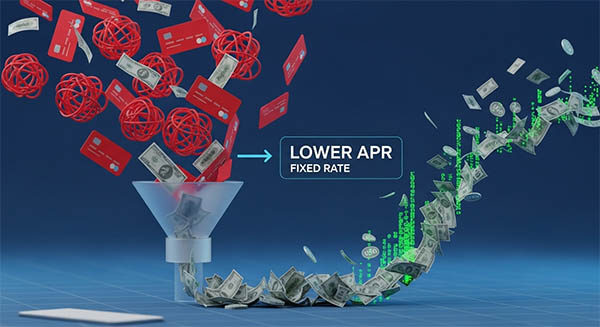
Welcome back to The FinTech Verdict. I’m your Senior Financial Analyst, and today we’re tackling one of the most critical decisions facing Americans buried under high-interest debt: whether to pursue a Debt Consolidation Loan. If you are feeling the constant pressure of multiple high-interest credit card payments, medical bills, or other scattered revolving credit balances, the idea of rolling everything into a single, predictable monthly payment with a lower APR can sound like a miracle solution. But is it?
The truth is, while a Debt Consolidation Loan is a powerful financial tool, it is not a cure-all. It’s essentially a new unsecured personal loan that you use to pay off your old debts, leaving you with one lender and a new set of terms. This move can save you thousands of dollars in interest and significantly shorten your debt-free timeline, but only if you secure a favorable fixed rate and commit to a disciplined repayment plan. Making this decision requires a cold, hard look at your finances and the various FinTech options available today.
Many people stumble into debt consolidation without fully understanding the impact of fees, the difference between a fixed rate and a variable rate, or how their credit score influences the final offer. As your trusted analyst, I’m here to cut through the noise. We will analyze the mechanics of these loans, compare the best platforms in the market for 2026, and help you determine if this strategy aligns with your long-term goals for improving your financial health and FICO Score.
The potential benefits are enormous—imagine the relief of trading 29% interest rates for an offer closer to 12%. However, the risk lies in simply transferring the debt without addressing the underlying spending habits. Our goal today is to equip you with the knowledge to execute this consolidation move strategically and ensure you finally draw a line in the sand against high-interest debt. Let’s dig into the details to empower your decision.
The Core Mechanics: How a Debt Consolidation Loan Actually Works
A Debt Consolidation Loan is a type of unsecured loan that is not backed by collateral (like a house or car). You borrow one lump sum of cash, which is typically large enough to cover all the debts you wish to consolidate—often high-APR credit card balances. The best FinTech lenders will even pay your original creditors directly, ensuring the money is used exactly as intended. Once the loan is funded, you are left with just one bill: the new loan payment.
The primary benefit lies in the interest rate structure. Credit card debt is revolving credit with a high, often variable APR that rarely dips below 20% for average consumers. A successful Debt Consolidation Loan, however, should offer a significantly lower APR and, critically, a fixed rate. This means your payment is predictable, the interest cost is lower, and you have a definite end date for your debt, forcing a disciplined payoff that was impossible with minimum credit card payments. This structural change is key to escaping the debt cycle.
The viability of a Debt Consolidation Loan hinges on your personal credit profile, specifically your FICO Score and your debt-to-income ratio (DTI). Lenders use a hard inquiry on your credit report to assess your risk, and your qualification for the lowest rates is directly proportional to your score. A strong FICO Score (700+) usually unlocks the most competitive APRs, which is the whole point of consolidation. Remember, the loan must simplify your financial life, not complicate it with hidden origination fees or an APR that isn’t substantially lower than your current weighted average.
Top 3 FinTech Platforms for Debt Consolidation Loans in 2026
The lending landscape is fiercely competitive, with FinTech platforms consistently beating out traditional banks on speed and user experience. When selecting an unsecured personal loan for consolidation, the key metrics are the lowest starting APR, the absence of origination fees, and a seamless application process. We’ve evaluated three top contenders dominating the 2026 market for their transparency and value.
LightStream (Truist): Best for Excellent Credit and No Fees
LightStream, the online lending division of Truist, consistently offers some of the lowest starting APRs in the industry for borrowers with exceptional credit. They pride themselves on a “no fee” promise, meaning there are no origination fees, no late fees, and no prepayment penalties. This transparency is vital, ensuring that the advertised lower APR is the true cost of the loan.
The Financial Verdict: LightStream is the gold standard for high-score borrowers (typically 700+ FICO Score) looking to maximize savings. Their rates start as low as 6.24% APR (with AutoPay) and loan amounts go up to $100,000, which is ideal for large consolidation projects. The requirement for excellent credit is their main barrier, but if you qualify, they provide an unbeatable fixed rate and quick funding, sometimes the same day, making them excellent for time-sensitive debt payoff.
Marcus by Goldman Sachs: Best for Fee-Free and Transparent Terms
Marcus stands out for its straightforward, consumer-friendly approach, offering personal loans with zero origination fees, zero late fees, and zero prepayment penalties. This dedication to zero fees means that the APR you are quoted is the rate you pay, without hidden costs being deducted from your loan proceeds. Their focus on eliminating junk fees makes them a highly trustworthy option for a Debt Consolidation Loan.
The Financial Verdict: Marcus offers loans up to $40,000 with competitive APRs ranging from approximately 6.99% to 24.99% (with an AutoPay discount). This makes them a great contender for those with good-to-excellent credit (often 680+ FICO Score) who value transparency. By offering a fixed rate and flexible terms (36 to 72 months), Marcus makes budgeting simple, allowing you to clearly plot your path to becoming debt-free and improving your debt-to-income ratio (DTI).
SoFi: Best for High Loan Amounts and Member Benefits
SoFi (Social Finance) is a FinTech powerhouse known for its large loan amounts and extensive membership perks. They offer unsecured personal loans up to $100,000, making them perfect for large-scale consolidation, such as combining high-balance credit card debt with a large medical bill or even student loan debt. SoFi also offers competitive APRs starting from the mid-8% range.
The Financial Verdict: While SoFi offers optional origination fees (up to 7%) that can be paid to secure a slightly lower APR—a strategy similar to “buying points” on a mortgage—their competitive advantage is in their benefits package. This includes career coaching and financial planning services, which can be invaluable for fixing the financial habits that led to the debt in the first place. Their typical borrower has a strong credit profile (average FICO Score around 745), ensuring they are targeting those who qualify for a favorable fixed rate.
Key Takeaway: The goal of consolidation is to lower the total cost of debt. Prioritize lenders like LightStream and Marcus that have zero origination fees, or use a platform like SoFi strategically to get a high loan amount if your excellent FICO Score qualifies you for a rock-bottom APR.
When a Debt Consolidation Loan is the Right Financial Move
Deciding to take out a Debt Consolidation Loan requires careful self-assessment. The move is appropriate and highly effective when two main conditions are met: (1) You can secure a lower APR than the average interest rate of your existing debts, and (2) You have fixed the behaviors that created the debt. This move is not just about refinancing; it’s about financial restructuring.
The Balance Transfer Alternative: When a 0% APR Credit Card Wins Out
If your total debt amount is relatively small (under $15,000) and your FICO Score is strong (720+), a balance transfer credit card might be a better, fee-free alternative. Many credit card issuers offer 0% introductory APRs on transferred balances for a period of 12 to 21 months. If you are confident you can pay off the entire debt within this introductory period, you save on all interest.
The catch is the balance transfer fee, which is typically 3% to 5% of the amount transferred. If you can pay the debt off quickly, that 3% fee is significantly less costly than even the lowest Debt Consolidation Loan APR of 6–7%. However, if you cannot pay it off, the APR will jump to a high variable rate at the end of the promotional period, making the Debt Consolidation Loan the safer bet with its long-term fixed rate.
Analyzing Your Debt-to-Income Ratio (DTI) Threshold for Approval
Your Debt-to-Income Ratio (DTI) is a crucial metric lenders use to determine your ability to manage monthly payments. It is calculated by dividing your total monthly debt payments by your gross monthly income. Most FinTech lenders prefer a DTI of 43% or less, though many aim for 36% for their best rates. If your DTI is too high, you might be denied, or you might be offered a very high APR, defeating the purpose of consolidation.
Before applying for a Debt Consolidation Loan, calculate your current DTI. Then, estimate what your new DTI will be after consolidation. If the new loan payment significantly reduces your DTI (by replacing multiple high minimum payments with a single, lower one), it signals to future lenders that your financial situation has stabilized, which indirectly supports your FICO Score health.
Understanding the Hard Inquiry Impact on Your FICO Score
Every time you formally apply for a Debt Consolidation Loan, the lender performs a hard inquiry on your credit report. This temporarily dips your FICO Score by a few points and stays on your report for two years. To minimize the damage, shop around for rates in a short, concentrated window (often 14 to 45 days, depending on the FICO model). Multiple inquiries for the same type of loan within this window are typically grouped and count as only one hard inquiry.
This strategic shopping is critical. Never apply for multiple loans simultaneously without checking your pre-qualification options first, as these use a soft inquiry and have no impact on your FICO Score. Once you find the most favorable rate, commit to the application. The minor, temporary hit from the hard inquiry will be quickly overshadowed by the positive long-term impact of lowering your credit utilization ratio and demonstrating reliable fixed rate payments.
How to Strategically Select the Best Unsecured Loan (APR, Fees, and Transparency)
The final choice between unsecured personal loan platforms must be based on objective data. The lowest advertised APR is just the starting point; you must look deeper into the overall loan cost structure.
1. Scrutinize the Annual Percentage Rate (APR): The APR is the single most important number because it represents the total annual cost of the loan, including the interest rate and any required fees. Always aim for a fixed rate—never a variable rate for consolidation—to ensure your payment remains predictable. The ultimate goal is a lower APR that beats your weighted average credit card interest rate by at least 5 percentage points to make the move financially worthwhile.
2. Watch Out for Origination Fees: An origination fee is a one-time charge, often 1% to 8% of the total loan amount, deducted from the loan proceeds before the funds are dispersed. For example, a 5% origination fee on a $20,000 Debt Consolidation Loan means you only receive $19,000. You need to account for this fee when determining if the loan is large enough to cover all your existing debt. Lenders like Marcus and LightStream that offer no origination fees provide the clearest path to consolidation.
3. Demand Transparency on Prepayment Penalties: Always confirm that the unsecured personal loan has no prepayment penalty. The entire point of a Debt Consolidation Loan is to pay it off faster than the original term, and a prepayment penalty would undermine this strategy. The best FinTech platforms are transparent about their fee structure, allowing you to pay down the principal aggressively without fear of hidden costs.
Debt Consolidation Loan FAQs
❓ What is the main difference between a fixed rate and a variable rate loan?
A fixed rate loan means the interest rate and your monthly payment will remain exactly the same for the entire life of the loan term. A variable rate loan means the interest rate can change based on market indices (like the prime rate), causing your monthly payment to fluctuate. For a Debt Consolidation Loan, always choose a fixed rate to guarantee predictability and budgeting certainty.
❓ Will getting a Debt Consolidation Loan hurt my FICO Score?
Temporarily, your FICO Score may see a slight drop due to the hard inquiry when you apply. However, the long-term effect is overwhelmingly positive. By paying off high revolving credit balances, you dramatically lower your credit utilization ratio (a massive 30% factor in FICO) and replace scattered high-interest debt with a single, reliably paid installment loan, which signals stability and discipline.
❓ Can I consolidate my student loan debt with a Debt Consolidation Loan?
Technically, you can consolidate private student loans with a personal loan (which is what a Debt Consolidation Loan is). However, you generally cannot use an unsecured personal loan to consolidate federal student loans. Furthermore, personal loan rates may be higher than current student loan rates, so always compare the final APR carefully. It often makes more sense to look at specialized student loan refinancing if the goal is a lower rate on education debt.
❓ What is the most critical factor to check before accepting a loan offer?
The single most critical factor is ensuring the final APR (which includes all fees) is significantly lower than the average interest rate you are currently paying on your consolidated debts. If the APR is not low enough to offset any origination fee and save you money over the loan term, the Debt Consolidation Loan is not worth the temporary credit score hit from the hard inquiry.
Take Control of Your Debt Narrative
Choosing a Debt Consolidation Loan is a powerful financial move—it’s your chance to reset your debt clock and secure a brighter financial future. The core of this strategy lies in locking in a fixed rate with a substantially lower APR than your current debt, and diligently choosing a platform that minimizes fees, such as those that proudly offer no origination fees.
If you can qualify for a competitive rate from a transparent FinTech lender like LightStream, Marcus, or SoFi, the benefits of simplifying your budget, lowering your cost of debt, and improving your long-term FICO Score are undeniable. Don’t just transfer the problem; solve it. Calculate your DTI, commit to a long-term plan, and take the decisive step to escape high-interest debt today.
Key Takeaway: The success of a Debt Consolidation Loan is not determined by the loan itself, but by the borrower’s ability to secure a low-fee, fixed rate APR and adhere to a strict payoff plan that prevents future high-interest debt accumulation.
Disclaimer: This content is for informational purposes only. The FinTech Verdict is not a financial institution and does not offer credit counseling or debt consolidation services. Consult a certified financial planner for advice tailored to your personal financial situation.
