
The Vault Verdict: The Best High-Yield Savings Accounts (HYSA) for Your Emergency Fund in 2026

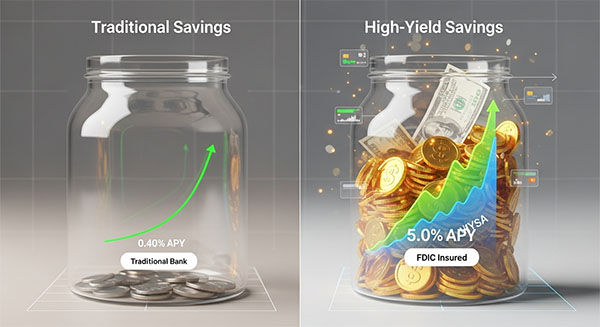
Welcome back to The FinTech Verdict. I’m your Senior Financial Analyst, and today we’re focusing on the bedrock of financial security: your cash. Specifically, your emergency fund and how to ensure it’s working as hard as possible. If your savings are sitting in a traditional bank account earning the national average of 0.40% Annual Percentage Yield (APY), you are losing money to inflation every single day.
You need to move your cash to High-Yield Savings Accounts (HYSA). These accounts are offered primarily by online banks and challenger banks and offer drastically higher APYs—often 10x the national average—while providing the same critical security: FDIC Insured protection up to the maximum allowable limits. This is the simplest, most effective financial decision you can make for your short-term liquidity without taking on any investment risk.
The key is finding the right platform. The market is constantly changing, with banks competing fiercely for deposits. We must look beyond the headline APY to examine crucial factors like hidden fees, minimum balance requirements, and the speed of funds transfer. We will analyze the mechanics of an HYSA, compare the top three transparent online bank providers in the market for 2026, and show you exactly how to maximize your cash without compromising safety or liquidity.
The Core Mechanics: Why High-Yield Savings Accounts Beat Traditional Banks
The concept behind High-Yield Savings Accounts is simple: they offer significantly higher Annual Percentage Yield (APY) than conventional banks. The reason online banks can do this is structural. Traditional banks operate expensive branch networks, paying rent, utilities, and staffing costs. Online banks avoid these massive overheads and pass the resulting savings on to depositors in the form of a higher APY.
Crucially, HYSAs must provide the same federal guarantee as any traditional account. Always ensure your account is FDIC Insured up to the standard maximum of $250,000 per depositor, per insured bank, per ownership category. This protection means that even if the bank were to fail, the U.S. government guarantees the return of your deposits up to the legal limit. Therefore, there is zero risk difference between keeping your emergency fund in a local branch or in a high-APY online bank.
The high APY of these accounts is variable and directly tied to the Federal Reserve’s benchmark rate. When the Fed raises rates (as is common in late 2025/early 2026), HYSAs quickly adjust their APY upwards, giving you substantial returns on your cash. Conversely, traditional banks are notoriously slow to adjust their rates, resulting in a lag that costs their customers hundreds of dollars annually. For short-term cash needs, like your emergency fund, an HYSA offers unparalleled growth combined with full liquidity.
The 3 Best Online Banking Platforms for High-Yield Savings Accounts in 2026
When selecting the best HYSA, the primary criteria are the highest sustainable APY, the lack of no fees, and user-friendly access features. We’ve evaluated three of the most transparent online bank platforms that consistently lead the market.
Ally Bank: Best for User-Friendly Tools and No Fees
Ally Bank is frequently cited as the gold standard for online bank user experience. Their High-Yield Savings Accounts typically feature a competitive APY on all balance tiers and, critically, have no fees for monthly maintenance, minimum balances, or standard ACH transfers. Ally is particularly innovative with features like “Savings Buckets,” allowing customers to visually divide their emergency fund into different savings goals (e.g., “Car Repair Fund,” “Vacation Fund”) without opening multiple accounts.
The Financial Verdict: Ally is ideal for the average user who wants a seamless digital experience backed by high security and transparent terms. Their robust app, 24/7 customer support, and automatic saving features like “Surprise Savings” (analyzing linked checking accounts to transfer safe-to-save money) make them a top-tier choice for your emergency fund. Ally is fully FDIC Insured and maintains its reputation for being fee-free, maximizing the benefit of the Annual Percentage Yield.
Discover Bank: Best for Zero Fees and Banking Integration
Discover Bank, a division of the credit card company, offers a highly attractive High-Yield Savings Account with no fees and no minimums to open or maintain the account. Their APY is competitive and applied to all balances. A significant advantage is their strong suite of integrated banking products, including checking accounts that offer cash-back rewards on debit purchases and CDs (certificates of deposit).
The Financial Verdict: Discover is a trustworthy choice for users who might want to transition their entire banking relationship to a single online bank platform that offers full transparency and no fees. The fact that they have no minimum balance requirement ensures that even those just starting their emergency fund can immediately access the high APY. Like all reputable online banks, Discover is FDIC Insured and boasts reliable 24/7 U.S.-based customer service.
Capital One 360 Performance Savings: Best for Hybrid Access and High APY
Capital One’s 360 Performance Savings account offers a competitive APY with no minimums and no fees. What sets Capital One apart in the online bank landscape is its hybrid model: while it operates mostly online, customers can still visit Capital One Cafés and even some physical branches for in-person support. The seamless integration with its highly-rated 360 Checking account allows for instant transfers, crucial for maintaining liquidity when funding your emergency fund.
The Financial Verdict: This account is perfect for users who value the high Annual Percentage Yield and no fees of an online bank, but still desire the comfort of knowing there’s a physical presence or ATM network available. Capital One provides an excellent blend of digital convenience and traditional bank familiarity, all while providing the necessary FDIC Insured protection up to the allowable limits. Their automatic savings features also make it easy to consistently build your emergency fund.
The Strategic Edge: Maximizing Your Cash with an HYSA
Moving your cash is not just about earning more; it’s about strategic financial planning that impacts your entire financial health. An HYSA provides the perfect balance between risk-free growth and accessibility.
Liquidity vs. Return: Why an HYSA is Better Than a CD
When planning your emergency fund, liquidity (easy access to your cash) is paramount. While certificates of deposit (CDs) often offer a slightly higher APY, they lock your money up for a fixed term (e.g., 6 months or 1 year) and charge stiff penalties for early withdrawal. An HYSA, however, allows immediate access to your cash, maintaining the necessary liquidity for true emergencies.
The APY on an HYSA is variable, but the highest rates in the market are often competitive with shorter-term CDs without the lock-up risk. Therefore, for cash you might need quickly—such as your emergency fund—the HYSA offers a superior risk-adjusted return profile compared to a certificate of deposit.
Protecting Your Funds: The FDIC Insured and Ownership Categories
It is essential to understand the maximum FDIC Insured limit of $250,000 per person, per insured bank, per ownership category. If you have $200,000 in a savings account (Single Account) and $100,000 in a joint savings account at the same online bank, your single account is fully insured, but your joint account is also separately insured (up to $500,000 for two owners), ensuring maximum coverage.
If your total cash holdings exceed $250,000 in a single ownership category, you can easily open a second High-Yield Savings Account at a different online bank to ensure all your funds are fully protected. This simple strategy allows for safe, high-APY growth well beyond the standard limit.
The Money Market Account vs. HYSA Debate
A money market account (MMA) is often compared to an HYSA. MMAs typically offer a competitive APY and, unlike HYSAs, usually provide check-writing privileges or a debit card. However, MMAs often require a higher minimum balance to waive potential fees and their APY is not always superior to the best HYSAs. For a basic, no-frills emergency fund seeking the maximum interest, the simplicity and superior no fees policy of a top HYSA usually wins out.
How to Select the Optimal High-Yield Savings Account (APY, Fees, and Access)
Choosing the best HYSA requires focusing on three non-negotiable elements. Never be swayed solely by a temporary promotional APY rate.
1. The True Annual Percentage Yield (APY): Look for an online bank that offers a consistently high, non-promotional APY across all balance tiers and has a history of quickly adjusting its rate upward when the Fed increases its benchmark rate. A difference of 0.5% APY on a $20,000 emergency fund is $100 a year—free money you are leaving on the table.
2. Zero Fees, Zero Minimums: For an emergency fund, the account must have no fees (monthly maintenance, transfer fees, etc.) and no minimums. Fees erode the benefit of the high Annual Percentage Yield. The top online bank options listed above all meet this crucial criterion, ensuring every dollar you save goes toward growth, not costs.
3. Seamless Liquidity and Access: Ensure the online bank offers fast, free ACH transfers to your external checking account. While federal rules limit withdrawals from savings accounts to six per month, your emergency fund needs to be easily accessible when you need it most. The best platforms, like Ally and Capital One, also offer robust mobile apps for managing funds quickly and efficiently.
High-Yield Savings Accounts FAQs
❓ Is the APY on a High-Yield Savings Account guaranteed?
No. The APY on an HYSA is variable and subject to change based on market conditions and the Federal Reserve’s interest rate policy. It is not a fixed rate. However, online banks are forced to keep their APY competitive to attract deposits, so rates usually track closely with the best offerings in the market.
❓ Is an online bank as safe as a local branch bank?
Yes, absolutely. Safety is determined by insurance, not location. If the online bank is FDIC Insured—which all the reputable ones are—your deposits are protected up to the legal limit of $250,000 per ownership category, just like deposits at your local branch. The only difference is the physical branch network.
❓ Do I pay taxes on the interest earned in my HYSA?
Yes. The interest earned from your High-Yield Savings Accounts is considered taxable income. The bank will send you a 1099-INT form if you earn $10 or more in interest during the calendar year. This is the same taxation rule that applies to interest earned in a traditional savings account.
❓ What is the main downside of a High-Yield Savings Account?
The main downside is the limited in-person service and the inability to easily deposit physical cash. Since online banks do not have physical branches, cash deposits often require buying a money order or using a partner ATM network. For the majority of users who handle transactions digitally, this downside is easily outweighed by the benefit of the high APY and no fees.
Key Takeaway: For your emergency fund, the best High-Yield Savings Accounts offer the trifecta of financial stability: a high, competitive APY, guaranteed FDIC Insured protection, and the necessary liquidity with no fees or minimums.
Stop Leaving Money on the Table
If you are committed to building your wealth and improving your financial security, optimizing your cash flow is non-negotiable. Moving your emergency fund from a traditional bank to a top-tier High-Yield Savings Account is the easiest way to generate significant, risk-free returns.
Platforms like Ally, Discover, and Capital One 360 allow you to maximize your Annual Percentage Yield while benefiting from full FDIC Insured protection. By choosing an online bank that offers no fees and no minimums, you ensure every dollar you save works for you. Stop funding your bank’s branch network; start funding your financial future today.
Disclaimer: This content is for informational purposes only. The FinTech Verdict is not a financial institution and does not provide financial or banking advice. Consult a certified financial planner for advice tailored to your personal financial situation.