
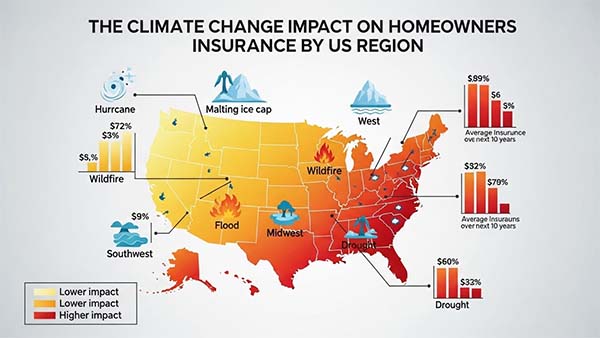
The cost of owning a home in the US has always involved three pillars: the mortgage, property taxes, and homeowners insurance. For decades, insurance felt like the static, dependable pillar. But today, the ground beneath that pillar is shifting dramatically. For millions of Americans, the cost of homeowners insurance is soaring, driven by a single, powerful factor: climate change risk.
Finding the right coverage is no longer just a matter of price shopping; it’s a deep analysis of your local environmental risk profile. The Climate Change Impact on Homeowners Insurance premiums is now a dominant financial factor in regional housing markets, eroding home values and pushing household budgets to the limit. We’re seeing a fundamental repricing of disaster risk across the country. This expert guide will break down exactly how climate change is redefining insurance premiums, examine the most vulnerable US regions for 2026, and provide actionable strategies to protect your budget and your home.
The New Mechanics of Premium Pricing
Today, major carriers rely on sophisticated Catastrophe (CAT) Models. These models use complex simulation and geospatial analytics to project potential losses from future climate scenarios—not past ones. They factor in rising reinsurance costs and increasing reconstruction costs. This extreme level of risk assessment is the core driver of the increased Climate Change Impact on Homeowners Insurance premiums you are seeing across the board.
From Historical Data to Catastrophe Modeling
For decades, insurance companies used historical loss data—looking back 30 to 50 years—to predict future claims. This model is now broken. Climate change has accelerated the frequency and severity of catastrophic events (CAT losses) beyond all historical averages.
Today, major carriers rely on sophisticated Catastrophe (CAT) Models. These models use complex simulation and geospatial analytics to project potential losses from future climate scenarios—not past ones. They factor in:
Increased Reinsurance Costs: Primary insurance carriers buy insurance from global reinsurance companies to cover massive losses from disasters. Reinsurance costs have reportedly more than doubled in recent years, and those costs are directly passed to you, the homeowner.
Rising Reconstruction Costs: Inflation, tariffs, and supply chain disruptions have dramatically increased the price of materials and skilled labor. The Insurance Information Institute estimates cumulative replacement costs increased by over 50% between 2020 and 2022, forcing higher coverage limits and subsequently, higher premiums.
Risk Sophistication and Financial Stability
This focus on future risk has made insurance pricing incredibly granular. You are no longer just pooled with your county; you are priced based on your ZIP code’s specific elevation, vegetation risk, and proximity to flood zones, leading to highly customized, and often significantly higher, pricing for high-risk homes.
Projected average data for 2026, based on 2025 Cotality and Realtor.com research, indicates that the average US homeowner insurance premium is expected to rise by approximately 8% in 2026, driven by these factors, making insurance costs the highest percentage of the typical homeowner’s total monthly payment on record. This rising cost is forcing millions of homeowners to scrutinize their expenses, a necessary practice akin to implementing strict zero-based budgeting to maintain housing affordability.
Regional Breakdown: The Geography of Risk
The impact of climate-driven premium hikes is far from uniform. It is creating distinct zones of extreme risk and cost across the US. This regional disparity highlights why the Climate Change Impact on Homeowners Insurance is now a localized, ZIP-code-specific financial challenge.
Gulf Coast (Florida, Louisiana, Texas): Best for Wind and Hurricane Risk Modeling
The Gulf Coast remains the epicenter of the insurance crisis, primarily driven by hurricane intensity and coastal flooding. States like Florida and Louisiana have seen the most drastic consequences, including carrier insolvencies and mass insurer withdrawal. This region best exemplifies the devastating and immediate Climate Change Impact on Homeowners Insurance.
The Problem: Carriers have been unable to charge premiums commensurate with actual risk due to state regulation, leading to massive losses from hurricanes (like Ida and Ian).
Analyst Insight: In high-risk parishes of Louisiana, some homeowners have seen annual premiums quadruple, with some quotes reaching $20,000, forcing them onto high-cost, high-deductible state-sponsored residual market plans (like Florida’s Citizens or Louisiana’s last resort programs).
Specific Financial Impact: Many carriers now require percentage deductibles (e.g., 2% to 5% of the dwelling coverage limit) specifically for wind or hurricane damage, rather than a fixed dollar amount. For a $400,000 home, a 5% hurricane deductible means the homeowner is responsible for the first $20,000 in damage, a massive financial exposure.
Western States (California, Colorado, Arizona): Best for Wildfire Risk Mitigation
The Western US is grappling with escalating, year-round wildfire seasons. This region faces unique challenges where the risk is spreading from forested rural areas into the Wildland-Urban Interface (WUI), threatening millions of properties.
The Problem: Unlike hurricanes, which can be modeled with some predictability, wildfire risk is highly volatile, dependent on micro-climate factors, wind, and vegetation management.
Carrier Response: Major national insurers like State Farm and Allstate have publicly paused or severely limited new business in high-risk areas of California. Homeowners are increasingly forced into the state’s insurer of last resort, the FAIR Plan, which often offers less comprehensive coverage at higher prices.
Mitigation Focus: Insurers that remain, like Chubb or Pure, often require detailed Wildfire Mitigation Plans, including defensible space creation and mandatory roof/vent upgrades, offering policy credits or coverage only if these expensive hardening measures are met.
Midwest (Nebraska, Oklahoma, Texas): Best for Severe Convective Storms (Hail/Tornado)
The Midwest is frequently overlooked in climate discussions, yet it experiences the highest volume of CAT events globally: severe convective storms (SCS), including tornadoes and extreme hail.
The Problem: Hail damage, particularly, is pervasive and costly. Hail-prone states like Nebraska and Oklahoma often feature the highest average premiums in the country, surpassing coastal areas in many years.
Analyst Data: In parts of the Midwest, insurance payments are starting to consume more than a fifth of the average homeowner’s total housing payment.
Strategic Coverage: Homeowners in this region must pay close attention to the separate deductibles for wind and hail. If your policy dictates a higher deductible for these specific perils, you need to ensure your emergency fund can cover that significant potential out-of-pocket expense.
Proactive Defense: Strategic Tactics to Lower Your Premium
You are not powerless against rising rates. By strategically reducing your home’s risk profile, you can actively influence your premium and significantly reduce the Climate Change Impact on Homeowners Insurance cost you personally shoulder.
Harden Your Home Against Specific Perils: Invest in physical mitigation that directly addresses your region’s primary risk:
Wildfire Zones: Install ember-resistant vents, replace wood roofs with non-combustible materials, and maintain a “defensible space” (clearing vegetation near the home).
Hurricane/Wind Zones: Upgrade to impact-resistant shingles and install hurricane shutters or impact-resistant windows. States like Alabama and Florida offer grants (e.g., Strengthen Alabama Homes) for such retrofitting.
Hail/Storm Zones: Install Class 4 impact-resistant roofing. This often qualifies for a substantial premium discount (sometimes 20-30%) because it significantly reduces the likelihood of a major claim.
Raise Your All-Peril Deductible: This is the quickest way to reduce your premium. By accepting a $2,500 or $5,000 deductible (up from $1,000), you signal to the insurer that you can cover small, frequent losses. This makes you a more attractive, lower-risk customer, resulting in lower premiums and protecting your cash flow.
Leverage Smart Technology for Security and Water Monitoring: Install “smart home” systems. A comprehensive system might include:
Professional-monitored smart security (smoke, burglar, fire).
Water leak sensors placed near water heaters, washing machines, and sinks. Water damage and freezing pipes are massive, non-weather-related claims. Proactively preventing them can earn significant credits.
Shop the Residual Market Wisely (Last Resort): If private insurance pulls out of your area, you may be forced onto a state-run residual market plan (e.g., California FAIR Plan). These plans should be viewed as a temporary necessity, not a permanent solution, as they are often more expensive and less comprehensive than standard policies. Always look for ways to transition back to the private market.
Selection Criteria: Choosing a Climate-Resilient Carrier
When premiums are rising everywhere, simply looking at the sticker price is insufficient. You need an insurer with the financial stability to weather future catastrophic events and the technological sophistication to reward your mitigation efforts. The carrier’s ability to navigate the complex and rising Climate Change Impact on Homeowners Insurance market is paramount to your long-term protection.
Key Criteria for 2026:
Financial Strength Rating (A.M. Best): In a world of rising CAT losses, an A.M. Best rating of A or higher is non-negotiable. This rating confirms the carrier’s solvency and their ability to pay out massive claims following a regional disaster.
Mitigation Discount Program: Look for carriers that offer explicit, substantial discounts for the risk reduction measures you take. If they don’t reward your Class 4 roof, they are using outdated pricing models.
Claims Handling and Technology: Choose carriers known for quick, tech-driven claims processing, utilizing drone and satellite imagery for post-disaster assessment. Slow claims can put enormous financial stress on a family, making timely resolution just as critical as the final payout.
The Problem of Availability and Policy Non-Renewal
In high-risk areas, the key challenge is availability. Insurers are strategically reducing their exposure (their concentration of risk in a small area). This leads to:
Non-Renewal: Your insurer may decide not to renew your policy, even if you have a perfect claims history, simply because your ZIP code’s risk profile has increased. Non-renewal rates in the highest risk ZIP codes have been reported to be nearly double those in the lowest risk areas.
Policy Exclusions: Carriers in some areas are now explicitly excluding certain risks, forcing homeowners to buy separate, expensive policies. For example, some wind-prone policies may exclude “water damage caused by wind,” requiring minute attention to policy language.
This focus on future financial security, much like the considerations involved in a thorough term life insurance review, requires looking beyond the immediate price to the long-term solvency of the company you trust to protect your largest asset.
FAQs: Voice Search and Proactive Risk Management
Hey Google, why are my homeowners insurance rates increasing so dramatically?
Homeowners insurance rates are increasing dramatically due to three main factors: rising costs of construction materials, the increased frequency and severity of natural disasters driven by climate change, and the resultant spike in reinsurance costs for carriers.
What is a percentage deductible and how does it affect my claim payout?
A percentage deductible (e.g., 2% or 5%) is a dollar amount calculated as a percentage of your home’s total dwelling coverage, significantly raising your out-of-pocket costs, particularly in high-risk zones for named storms or wind.
What is the NAIC doing to help manage homeowners climate change risk?
The NAIC (National Association of Insurance Commissioners) is actively working to manage homeowners climate change risk by standardizing data collection for catastrophic losses, developing a national climate resilience strategy, and encouraging regulators to incentivize home-hardening measures.
Can smart home technology really lower my homeowners insurance premium costs?
Yes, smart home technology, particularly monitored leak and fire detection systems, can often lower your homeowners insurance premium costs by demonstrating to the insurer that you are actively taking steps to mitigate the high frequency of non-weather-related water and fire claims.
Does homeowners insurance cover flood damage from a hurricane?
No, standard homeowners insurance explicitly excludes flood damage, even if the flood is caused by a hurricane’s storm surge. Flood coverage requires a separate policy, typically purchased through the National Flood Insurance Program (NFIP).
Protecting Your Financial Future
he truth is unavoidable: the Climate Change Impact on Homeowners Insurance is reshaping the American real estate market. The price of risk is no longer theoretical; it is tangible, and it is rising. Homeowners today must evolve from passive premium payers to active risk managers.
By understanding the mechanics of catastrophe modeling, evaluating the specific risks of your region, and strategically hardening your home, you can mitigate the highest cost spikes and keep your coverage available. Ignoring these trends is a financial gamble you cannot afford to take, potentially costing you tens of thousands in deductibles or policy gaps.
Don’t wait for your next renewal notice. Protect your biggest asset now.
💰 ACT NOW: Ready to instantly compare policies and riders from top carriers? [Click here to lock in your lowest guaranteed cost and maximize your family’s financial protection.]
Disclaimer!: This content is strictly for informational and educational purposes only and does not constitute personalized financial, investment, or legal advice. Premium costs and projections for 2026 are based on 2025 actuarial trends, including industry reports from Cotality, the Insurance Information Institute (III), and the National Association of Insurance Commissioners (NAIC). Homeowners insurance rates and coverage availability are subject to underwriting guidelines, specific state regulations, and local climate risk modeling that changes frequently. Always consult with a licensed insurance professional in your state to assess your individual risk and verify policy coverage.
