Understanding Your Business Credit Score: Building and Maintaining a Strong Corporate Profile

For the small business owner, the Business Credit Score is the invisible engine that drives expansion, determines borrowing costs, and dictates vendor relationships. Unlike your personal FICO score, which largely remains private, your corporate credit profile is highly visible and actively used by lenders, suppliers, and even potential partners to gauge the risk of working with you.
If you plan to secure a favorable SBA loan, negotiate better net-30 vendor terms, or simply obtain one of the best business credit cards, understanding and optimizing your Business Credit Score is non-negotiable. However, this process is often shrouded in confusion, involving different reporting agencies and scoring models than the consumer world.
This comprehensive guide will demystify the corporate credit ecosystem for 2026. We will break down the primary scoring models (Paydex, Intelliscore, etc.), detail the critical factors that build a high score, and provide actionable strategies to establish and maintain a robust corporate financial identity that unlocks the best terms on capital.
The Core Mechanics of Business Credit Scores
A Business Credit Score is an independent rating of a company’s financial reliability and its history of debt repayment. Crucially, it is not tied to your Social Security Number (SSN) but to your Employer Identification Number (EIN).
The Three Major Bureaus and Their Scores
In the US, the business credit landscape is dominated by three main reporting agencies, each using its own proprietary scoring model:
Dun & Bradstreet (D&B) Paydex: The most famous score, ranging from 1 to 100. A score of 80 is considered excellent, meaning the business pays its creditors and vendors promptly. This score primarily focuses on payment history relative to terms (e.g., paying within 10 days of a Net-30 invoice).
Experian Commercial Intelliscore Plus: Ranges from 1 to 100. This model uses a broader range of data, including business demographics, public records (like liens or judgments), and firm size, providing a comprehensive risk assessment.
Equifax Business Delinquency Score: Ranges from 101 to 992. Equifax focuses heavily on payment delinquency and utilization rates, assessing the likelihood of a business defaulting on its obligations over the next 12 months.
Separating Corporate and Personal Credit
For new or small businesses, lenders almost always assess both the Business Credit Score and the owner’s personal FICO score (due to the personal guarantee requirement). However, building a strong corporate profile is the pathway to separating these two.
Financial Independence: A strong, established Business Credit Score allows your company to eventually apply for unsecured credit lines and larger equipment financing without the founder’s personal assets (like their home or savings) being tied up as collateral. This is a critical step in risk management.
Audit Trail: Maintaining separate credit profiles also greatly simplifies tax compliance and audit preparedness, providing a clean separation between corporate expenditures and personal financial decisions, a key element of comprehensive crypto asset tax reporting integrity.
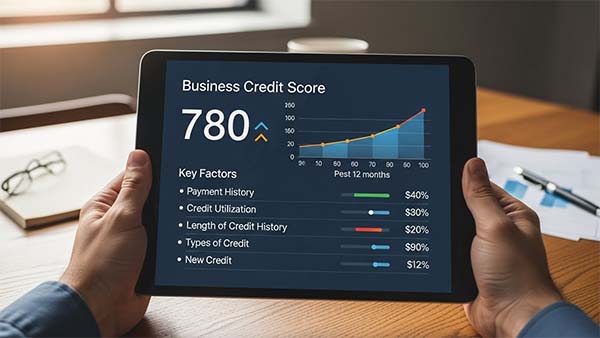
The Five Pillars of a Strong Business Credit Score
Unlike the personal FICO model (where payment history and utilization are key), the Business Credit Score leans heavily on timely payments to suppliers and how heavily you rely on credit.
1. Payment History (The Paydex Focus)
This is the single most important factor. The D&B Paydex score, in particular, rewards businesses that pay early.
The Target: A score of 80 or higher signifies that payments are generally made on time or slightly early. Paying 10 days before the invoice is due (e.g., Net-30 paid in 20 days) directly improves your Business Credit Score.
Analyst Insight: Late payments—even by a few days—are the fastest way to damage your score. Lenders view tardiness as an immediate red flag regarding cash flow stability, making it difficult to qualify for favorable terms like low interest rates on commercial loans.
2. Credit Utilization Rate
This measures how much of your available credit you are using. While a high utilization on a personal card severely damages your FICO score, it impacts your Business Credit Score differently, often measured as the “Maximum Credit Seeking Index.”
Best Practice: Aim to use less than 30% of your revolving credit limits (e.g., business credit cards or lines of credit). High utilization suggests financial strain and a reliance on debt to manage day-to-day operations.
3. Public Records and Financial Red Flags
Lenders and rating agencies actively monitor public records for signs of corporate distress.
Red Flags: Tax liens (state or federal), civil judgments, lawsuits, or bankruptcy filings will immediately and drastically depress your Business Credit Score. It takes significant time and effort, even after the issue is resolved, to erase the negative impact of public records. This is a high-stakes area of finance where the required diligence mirrors that of selecting the right coverage level during a term life insurance review.
4. Duration and Depth of Credit History
Just like with personal credit, a longer history of responsible borrowing demonstrates stability.
Strategy: Once you establish initial credit (see Strategic Guide below), keep those accounts open and active, even if the limits are low. The longer your average account age, the more reliable your Business Credit Score appears to be.
5. Business Demographics and Firmographics
Experian and Equifax consider the size, industry, and age of your company when calculating the score.
Industry Risk: Certain industries (e.g., construction, transportation) are perceived as higher risk. If you are in a high-risk sector, maintaining perfect payment history becomes even more critical to achieve a competitive Business Credit Score.
Strategic Guide: Building Your Corporate Profile from Scratch
If your business is new or relies solely on the owner’s personal credit, you must be proactive in establishing an independent corporate profile.
Step 1: Secure Your Foundation (EIN, LLC/Corp, Business Bank Account)
Before a lender can score you, you must officially exist as an entity.
Form a Legal Entity: Incorporate as an LLC or Corporation to establish legal separation from the owner.
Obtain an EIN: Get your Employer Identification Number from the IRS. This is your company’s “SSN.”
Open Dedicated Accounts: Open a dedicated business checking and savings account. Never commingle funds. This financial separation is essential for building a clean track record for your Business Credit Score.
Step 2: Establish “Tradelines” (Vendor Credit)
This is the most crucial, and often overlooked, step. Tradelines are credit accounts with suppliers or vendors that report your payment activity to the business credit bureaus (primarily D&B).
Net-30 Accounts: Seek out vendors (office supply companies, shipping providers, industry-specific suppliers) who offer Net-30 or Net-60 invoicing. This means you have 30 or 60 days to pay the invoice.
Reporting: Ensure the vendor actually reports to D&B or Experian. Many smaller vendors do not. You need at least three reporting tradelines active for a Business Credit Score to be accurately generated.
Actionable Tip: Once you have Net-30 accounts, pay the invoices 10–15 days early. This ensures you achieve the coveted D&B Paydex score of 80 or above.
Step 3: Secure Starter Credit and Monitor
Once you have established basic tradelines, seek small starter financing that reports to the bureaus.
Secured Business Credit Cards: These require a security deposit but report positively to the bureaus. They are an excellent, low-risk tool for jump-starting your Business Credit Score.
Monitor: Obtain your D&B report and Experian Intelliscore periodically. Check for errors, such as incorrectly reported late payments or outdated business addresses, which can negatively affect your score. Just like budgeting requires constant vigilance, monitoring your credit profile should be a core financial habit.
Selection Criteria: Business Credit Score and Lending Access
Your Business Credit Score directly translates into the type and cost of financing available to your company.
Score vs. APR: The Cost of Credit
A high Business Credit Score significantly lowers the cost of borrowing. Banks use the score to determine your risk, which in turn sets the interest rate (APR).
Low Score (50-65): You will likely be limited to short-term, high-interest FinTech loans or merchant cash advances, where APRs can reach 40% or higher.
High Score (75+ Paydex/Intelliscore): You qualify for traditional bank term loans and SBA-guaranteed loans, where APRs are projected to be in the favorable 8%–12% range in 2026, depending on macroeconomic conditions, saving your business substantial capital over the life of the loan.
Leveraging Credit for Vendor Negotiations
The value of a strong Business Credit Score extends beyond traditional borrowing. Suppliers and vendors often check your score before granting favorable terms.
Net-60/Net-90 Terms: A high score provides the leverage to negotiate Net-60 or even Net-90 terms, allowing you to hold cash for 60 or 90 days before paying a supplier. This dramatically improves your operating cash cycle and liquidity.
Insurance Costs: Some commercial insurance underwriters (Property & Casualty) may review commercial credit data, similar to how personal credit is used for auto insurance, potentially impacting premium quotes.
Regulatory Oversight and Transparency
While consumer credit is highly regulated (Fair Credit Reporting Act), business credit reporting has historically had fewer statutory requirements, leading to greater complexity. However, the Small Business Administration (SBA) and the CFPB are increasingly focused on transparency in commercial lending practices.
Right to Dispute: Even though the regulatory landscape differs, you maintain the right to dispute any inaccuracies on your D&B or Experian reports. Proactive monitoring prevents negative, erroneous data from compromising your corporate profile. You can learn more about business credit practices and data integrity from official government resources like the Small Business Administration (SBA).
Business Credit Score FAQs
What is the fastest way to get a business credit score?
The fastest way to get a business credit score is by opening and actively using three or more vendor Net-30 tradelines that report payment history to Dun & Bradstreet.
What is considered a good business credit score for bank loans?
A good business credit score for bank loans is typically a D&B Paydex score of 75 to 80 or higher, which demonstrates a strong history of timely payments to creditors.
Does a low business credit score affect my personal FICO rating?
No, a low business credit score does not directly affect your personal FICO rating unless the business defaults on a loan that required your personal guarantee.
How often should I check my business credit score for errors?
You should check your business credit score for errors at least quarterly, as discrepancies in payment or demographic data can severely and silently damage your corporate profile.
Why is my business credit score based primarily on payment speed?
Your business credit score is primarily based on payment speed because prompt payments to vendors are the clearest indicator of strong cash flow and low financial risk to potential lenders and suppliers.
Can a high business credit score help lower my insurance premiums?
Yes, a high business credit score can sometimes help lower commercial insurance premiums, as some underwriters use commercial credit data to assess the overall financial stability and risk profile of the business.
The Path to Corporate Independence
Your Business Credit Score is the ultimate metric of your company’s fiscal discipline and market viability. It is the passport to securing the lowest interest rates, negotiating the best supplier terms, and ultimately, achieving true financial independence from the personal guarantee of the founder.
Building this corporate profile is not an accident; it is a methodical process rooted in financial hygiene: formalizing your entity, securing reporting tradelines, and maintaining a policy of always paying vendors early. By prioritizing your Business Credit Score, you are not just preparing for the next loan; you are building a more resilient, scalable, and profitable enterprise.
Don’t leave your company’s future to chance. Take control of your corporate profile today. ➡️ GET STARTED: Learn more about your rights and access to commercial credit information and dispute resolution from the CFPB!
Disclaimer!: This content is strictly for informational and educational purposes only and does not constitute personalized financial, investment, or legal advice. Business Credit Score metrics (Paydex 80, Experian Intelliscore, etc.) are proprietary and subject to change by the reporting bureaus. Loan APR projections for 2026 are based on observed market trends and are estimates. Always consult with a qualified financial advisor and review the full terms and conditions before seeking any commercial credit product.